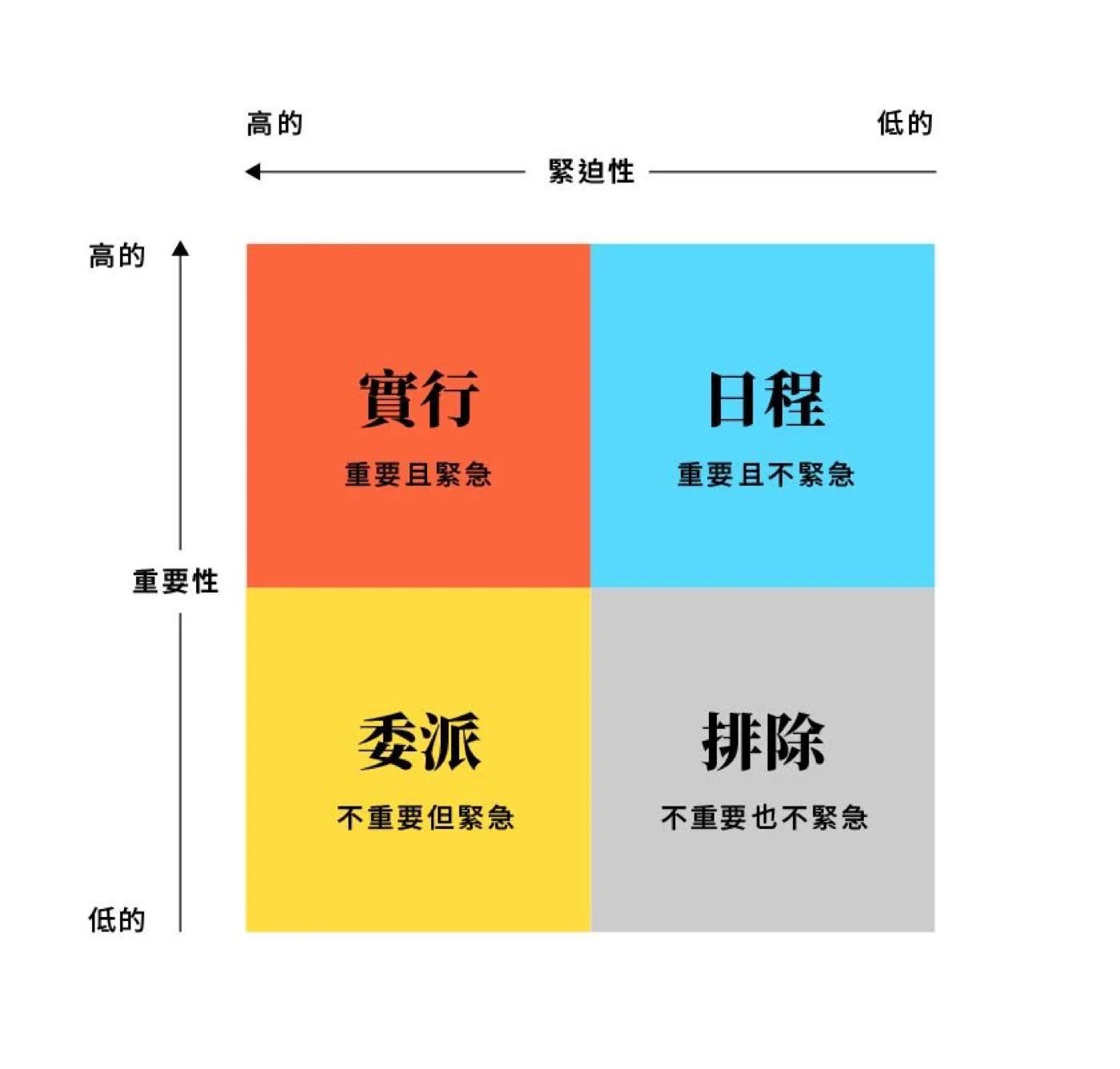
The Eisenhower matrix sorts work by urgency and importance into four boxes: do, schedule, delegate, delete. It is simple enough that most people abandon it within a week. Four habits keep it useful.
1. Colour-code the tasks
Colour is a quick way to make the high-priority work visible at a glance.
- Red — top priority
- Yellow — second
- Blue — third
- Grey — not a priority
Once tasks carry a colour, the colours give the matrix its meaning. Red tasks are the first quadrant — do them. Blue tasks are the second — schedule them. Yellow tasks are the third — delegate them. Grey tasks are the fourth — delete them.
2. Cap each quadrant at ten
However long the to-do list, keep each quadrant to no more than ten items. Past that, the matrix turns into clutter and stops helping.
You can run several matrices at once, but each list needs a limit. Pull out only what actually needs action and leave the rest, so that prioritising is not itself a way of losing time.
3. Keep work and life on separate boards
Another way to keep the count down is to run separate matrices for personal and professional tasks.
Work and personal tasks run on different timelines, draw on different resources, and often need a different kind of thinking. Keeping them apart is what lets you handle each properly.
4. Eliminate first, then prioritise
You can only prioritise well once the unnecessary work is gone. Deal with the fourth quadrant before you touch the first three.
As you scan the list, ask which items should not be on any quadrant at all. A lot of what fills a working day is incidental — passing on a status, chasing an approval, syncing with someone.
Clearing those quickly speeds up the whole prioritising pass, and it is worth doing a second round of elimination before you finish.